

Note: The poems in this post may not appear in the forms used by the poets if the post is read on a phone.
When I ask friends how they are, the response is often something like, “Fine, aside from the madness of [insert name of Trump Administration policy or official].” Recently, a friend said, “Every day seems like, ‘Well, aside from that, how did you like the play, Mrs. Lincoln?’” There appears to be no end to the profound disappointment, or outrage, over the actual or proposed actions of the federal government.
This has been compounded for me because I am Twin Cities-adjacent. My mother was from St. Paul and my father was from Minneapolis where I still have relatives.
What, then, is to be done? While not an immediate cure-all, there are valuable lessons in how poets have dealt with periods of catastrophic political leadership. W.H. Auden said, “Poetry makes nothing happen.” Even so, poetry crystalizes how we think, feel and cope. The actions to be taken as a result are up to us.
There is a long tradition of resistance poetry. Examples include works by poets of the Harlem Renaissance, antiwar poets who responded to armed conflict in every era, and poets who speak for oppressed populations.
Resistance poems are also accessible. Even poetry-wary high school students (I’ve known some) can appreciate the way resistance poems articulate our shared concerns about negative and harmful political dynamics.
Here are two resistance poems from 1991 and 2001 by American poets. The poems anticipate current events and resonate accurately and powerfully with them.
What Kind of Times Are These
by Adrienne Rich
There's a place between two stands of trees where the grass grows uphill
and the old revolutionary road breaks off into shadows,
near a meeting-house abandoned by the persecuted
who disappeared into those shadows.

I've walked there picking mushrooms at the edge of dread, but don't be
    fooled
this isn't a Russian poem, this is not somewhere else, but here,
our country moving closer to its own truth and dread,
it's own ways of making people disappear.

I won't tell you where the place is, the dark mesh of the woods
meeting the unmarked strip of light--
ghost-ridden crossroads, leafmold paradise:
I know already who wants to buy it, sell it, make it disappear.

And I won't tell you where it is, so why do I tell you
anything? Because you still listen, because in times like these
to have you listen at all, it's necessary
to talk about trees.

Baltimore native Adrienne Rich was a respected poet, essayist, and feminist. Rich received numerous literary awards over a long career. More about Rich and her politically charged life can be seen
The speaker in Rich’s 1991 poem, “What Kind of Times Are These,” confides in us in an intimate and low-key way. The poem establishes a grave tone without lecturing or hyperbole when the speaker describes the existence, but not the location, of the “place between two stands of trees.” It is in this place that the speaker has walked, picking mushrooms “at the edge of dread.” Rich’s alliterative metaphor is acutely current. Where are we today, if not at “the edge of dread”?
The poem is a model of concision. In three stanzas of one sentence each and a fourth stanza consisting of a rhetorical question (“…why do I tell you anything?”) and an answer (“…because in times like these to have you listen at all, it’s necessary/to talk about trees.”)
The speaker affirms that “this isn’t a Russian poem,” but rather it is America that is “moving closer to its own truth and dread/its own ways of making people disappear.” When governments establish their “own truth” as part of the process of “making people disappear”—whether immigrants, or the unhoused, or just general noncompliers—things are dire.
The enjambment, or continuation of sentences beyond the end of the line, emphasizes the dark work of “making people disappear” in the final words of each line. This is particularly true in the first (“uphill,” shadows,” “persecuted,” “shadows”) and second (“fooled,” “here,” “dread,” “disappear”) stanzas.
The speaker’s concern about the nation’s future (“this is not somewhere else but here”) is communicated personally and incompletely (the repeated “I won’t tell you” in the third and fourth stanzas.)
Critics have argued that “What Kind of Times Are These” responds to a 1939 poem by German writer Berthold Brecht that argued that the catastrophes of his era—Nazism and World War II—made it “almost a crime” to “talk about trees.”
More fundamentally, Rich’s poem asserts that talking about trees is required to make people pay attention to poetry or and to address the fundamental question, “What Kind of Times are These.”
In other words, no matter how many disappointments or shocks we endure because of the way America is being lead, we cannot focus on them to the exclusion of everything else in life, for example trees and other people.
As Rich writes, “…to have you listen at all, it’s necessary/to talk about trees.”
We are Not Responsible
by Harryette Mullen
We are not responsible for your lost or stolen relatives.
We cannot guarantee your safety if you disobey our instructions.
We do not endorse the causes of or claims of people begging for handouts.
We reserve the right to refuse service to anyone.

Your ticket does not guarantee that we will honor your reservations.
In order to facilitate our procedures, please limit your carrying on.
Before taking off, please extinguish all smoldering resentments.

If you cannot understand English, you will be moved out of the way.
In the event of a loss, you'd better look out for yourself.
Your insurance was cancelled because we can no longer handle
your frightful claims.  Our handlers lost your luggage and we
are unable to find the key to your legal case.

You were detained for interrogation because you fit the profile.
You are not presumed to be innocent if the police
have reason to suspect you are carrying a concealed wallet.
It's not our fault you were born wearing a gang color.
It is not our obligation to inform you of your rights.

Step aside, while our officer inspects your bad attitude.
You have no rights we are bound to respect.
Please remain calm, or we can't be held responsible
for what happens to you.
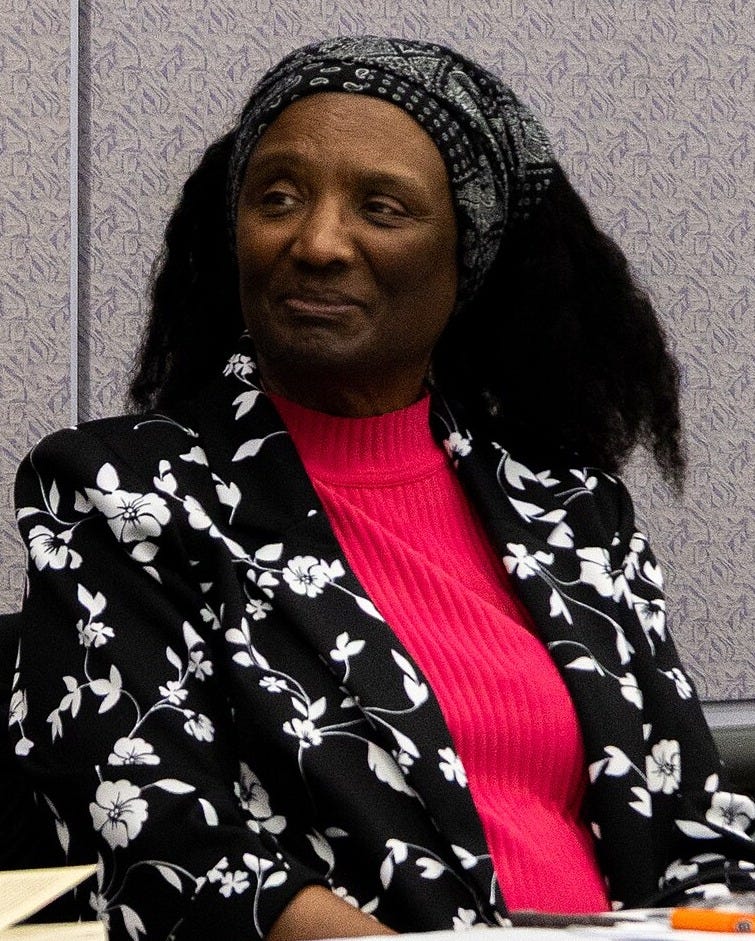
Harryette Mullen, an Alabama native, is a poet, short story writer, and professor at the University of California, Los Angeles. More about Mullen’s life and works can be found
“We Are Not Responsible” appeared in Mullen’s 2002 poetry collection, Sleeping With the Dictionary.
The poem’s short, staccato sentences, many of which end on a single line, mimic the directive language of bureaucratic control to confirm that the individual (the “you” in the poem) is subservient to a central authority. The speaker’s repeated descriptions of what “we” cannot or will not do (“We are not…” “We cannot…” “We do not…”) make the command-and-control relationship very clear.
The poem’s wordplay and puns (“…please extinguish all smoldering resentments”) and (…”we are unable to find the key to your legal case”) are compelling. They emphasize that the institution that supposedly provides a service, be it an airline or a government, does so on its own terms and for its own purposes, and not for the benefit of constituents.
“We Are Not Responsible” is poetry as announcement: a faceless and oppressive authority announces how things will be and what conduct by individuals will be, or not be, acceptable. The authoritarian directives come from the top.
The inverse of “We Are Not Responsible” might be Gil Scott-Heron’s 1971 poem and song “The Revolution Will Not Be Televised.” The poem is a Civil Rights era protest against institutional norms and the influence of the media.
In contrast to the top down messages of “We Are Not Responsible,” “The Revolution Will Not Be Televised” speaks for oppressed people seeking to change the status quo. Each poem has a compelling urgency.
You can hear Gil Scott-Heron recite “The Revolution Will Not Be Televised” here.
Your comments are very welcome.
Special thanks to Emmet Rosenfeld and Charlie Baxter for assistance with this post.
Thanks for reading About Alexandria!
Subscribe for free to receive new posts.