

Finally, some information you can use from this column.
In an unpleasant surprise, in mid-January I looked at my online banking program and saw two sizable (for me, anyway) unauthorized withdrawals, one from a checking account and the other from a money market account. The accounts were at a regional bank where I have been a customer for decades.
I immediately notified the bank of the unauthorized transactions. A short time later, I received a message from a bank employee who identified herself as a “client advocate” who recommended that both accounts be closed. I closed the accounts immediately and opened a new checking account at the bank.
It was a second unpleasant surprise when, a few days later, I saw two more unauthorized withdrawals in my new checking account, one through an electronic transfer and one through a clumsily forged check.
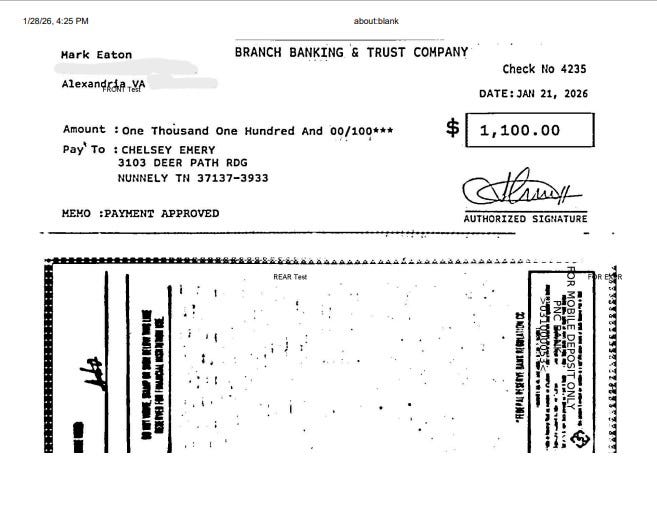
I notified the bank and my client advocate again. I was advised to close the new checking account and to terminate my online banking account, which I did. In summary, there were four fraudulent transactions in three bank accounts, including one that had been open for only a few days. I am not an expert in consumer banking security, but here is what I have learned.
Online banking demands vigilance. To anyone using online banking: check your account regularly. A daily review of online banking arrangements is not too often.
Small and unfamiliar offsetting credits and debits are suspicious. When I looked at the transaction history in the original checking and money market accounts, I saw small offsetting credits and debits of less than $1.00 around the Christmas holidays. I suspect, but cannot prove, these transactions were a fraudster testing for a possible later and larger withdrawal. As I used to tell my English classes about literature: nothing happens by accident.
Contact the bank and follow up. If you suspect a fraud, notify your bank immediately and assume the initiative to communicate until the matter is resolved. My client advocate was friendly and empathetic, but things moved forward only when I called to follow up. My client advocate’s title was appropriate—in the weeks after the fraudulent transfers took place I never talked to anyone from the bank’s fraud department, no matter how many times I asked for an explanation of how the fraudulent transfers occurred.
It can difficult or impossible to get a definitive account of how the fraud or frauds worked. I asked representatives of my bank on several occasions for an explanation of how the fraudulent transfers occurred, particularly since the four of them occurred closely in time.
At first, I was told that the most likely explanation was that someone had obtained my checking account number and the bank’s routing number. Account numbers and bank routing numbers are often printed on checks. It did not seem probable that a fraudster who obtained that information from a check would be able to convert it into electronic transfers, but maybe that is what happened.
Next, I was told that my online banking program may have been compromised. Accordingly, I closed that account and established a new one. Finally, I was told that the problem might be with the computer that I used to access online banking. The bank may be uncertain how the fraud occurred or, if the bank knows what happened it is unwilling to provide what could be a roadmap for fraud.
Get ready to make new arrangements. I learned that the accounts in which the frauds occurred do not need to be completely closed; they can be “locked” such that the accounts can process deposits, but no debits or withdrawals can be made without a trip to the bank. Even so, terminating a primary consumer banking relationship—in my case, twice—means redoing direct deposit and direct payment arrangements, getting new checks, a new debit card, etc. The good news is that the four fraudulent transactions were reversed, so my costs were mostly in time and inconvenience.
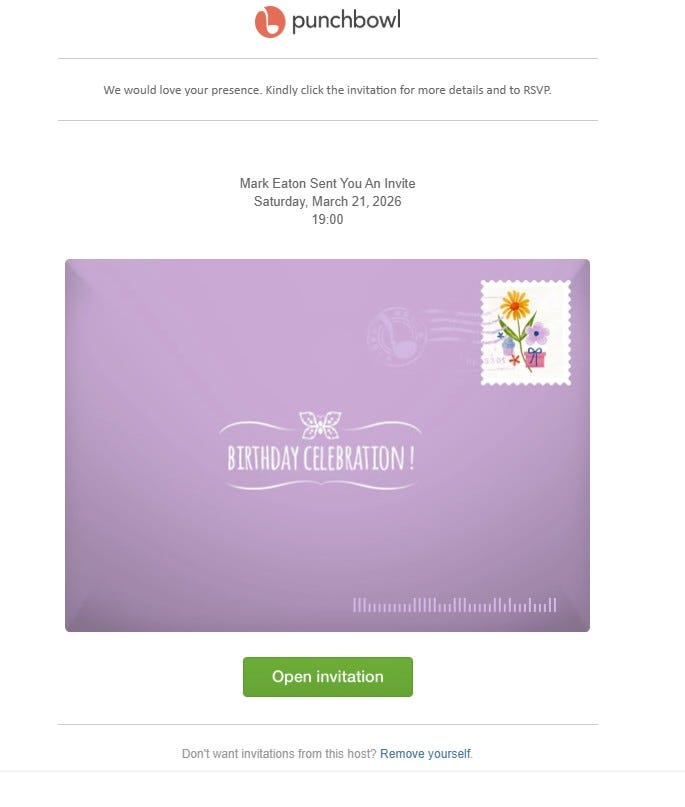
In February, I was the victim, or unwilling perpetrator, of an email scam. I received a bogus “Punchbowl” party invitation from a friend. The “invitation” was subsequently sent out as an email from me. Again, the experience was unpleasant, but I have learned to appreciate two-factor authentication and randomly generated passwords.
The essential learning, as high school teachers like to say, is that life online requires that, as playwright Arthur Miller wrote in Death of a Salesman, “Attention must be paid.”
The writer is a former lawyer, member of the Alexandria School Board from 1997 to 2006, and English teacher from 2007 to 2021 at T.C. Williams High School, now Alexandria City High School. He can be reached at aboutalexandria@gmail.com and free subscriptions to his newsletter are available at https://aboutalexandria.substack.com.
.
https://www.nytimes.com/2026/04/23/style/invitation-phishing-scam.html?smid=nytcore-ios-share
A good article with links to places to report scams as they multiply. Perhaps if everyone reported them we could slow it down.
It's unfortunate that you got bitten, Mark, and good that you are sharing it as a general cautionary tale.
A good rule-of-thumb is to treat every E-mail message, SMS text message, iMessage, and just about anything else coming your way with suspicion. It's called "social engineering" and it's about getting people to do things that are NOT in their best interest. Scammers are pros, good at what they do, and are experts in psychology.
It's not "Trust but verify," it's "Verify first, then (maybe) trust" (because by the time you try to verify, it's often too late). Before you follow a link in an E-mail message, call the purported source. Before you "confirm your account" for your bank, go to a (saved) bookmark for your bank and log in directly -- ignoring the link in the E-mail message (if your bank needed you to do something, you'll see it after logging in).
Computer CORE (computercore.org), a nonprofit in Alexandria that provides free digital literacy training, has a course called "Digital Self Defense" that is all about keeping yourself safe (with guidance like that in the preceding paragraph). I recommend people look into opportunities like that.