

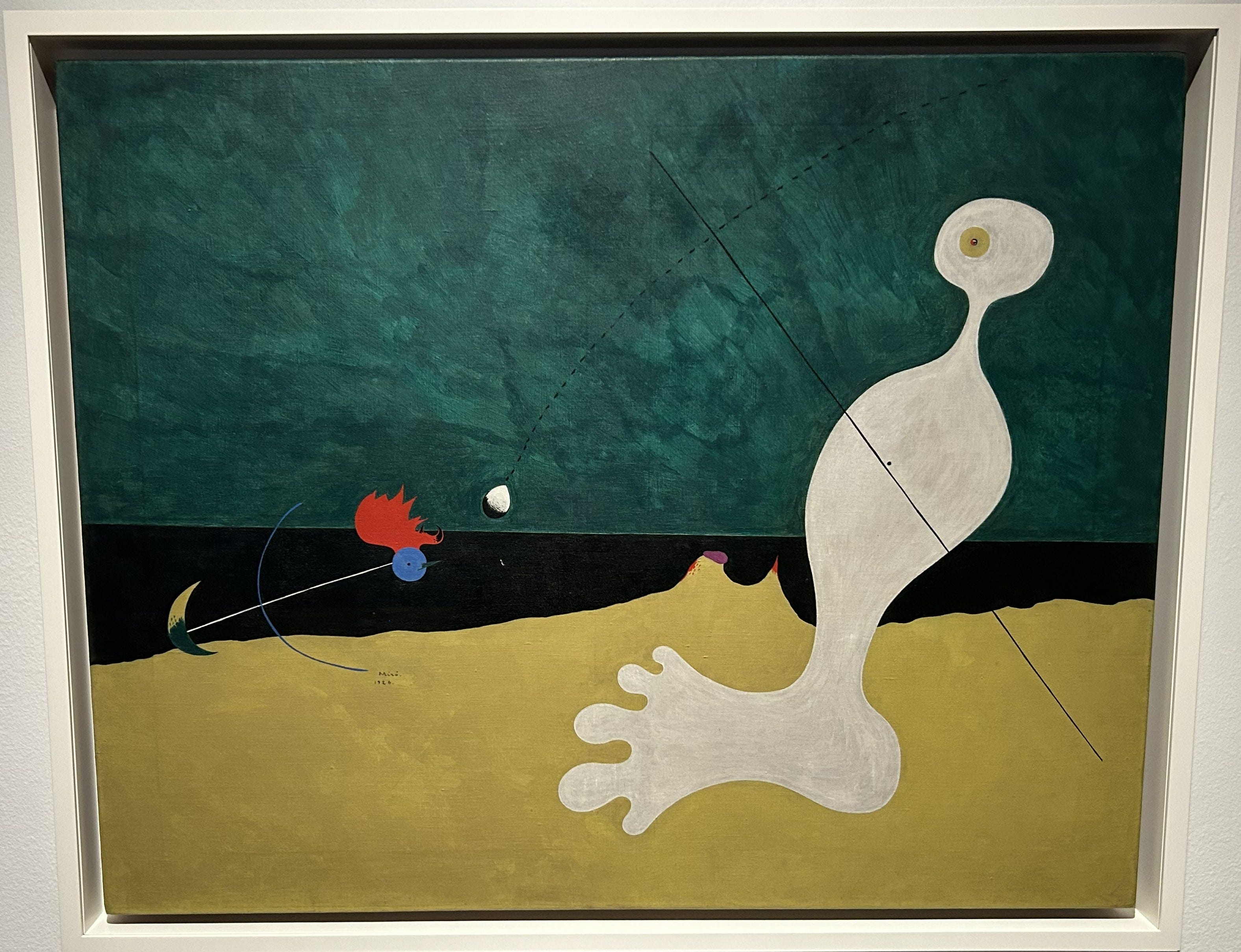
Somehow, if the Catalan artist Joan Miro′ (1893-1983) paints a person as a giant foot kicking a ball to a bird, the image makes sense. Miro′ visited the United States numerous times, sometimes for months, during his long and productive career. Near the end of his life Miro′ said, “It was American painting that inspired me.”
Miro′ and the United States, a special exhibition that runs through July 5, 2026 at the Phillips Collection in Washington, D.C., explores Miro′s connections with American artists such as Jackson Pollock, Helen Frankenthaler, and Lee Krasner and how those connections influenced 20th century art in the United States and Europe.
The exhibition is accompanied by a comprehensive and well-illustrated catalog in the form of a series of essays about Miro′, his travels and exhibitions in the United States, and his interactions with American artists. All page references in this post are to the catalog.
The 75 works from more than 30 artists on display at the Phillips Collections show that 20th century cultural and artistic influences did not travel exclusively from Europe to this country. In a 1947 interview, Miro′ spoke of the “energy and vitality…enthusiasm and freshness” of American painting. (67)
More about the exhibition can be seen
The exhibition begins on the Phillips Collection’s third floor with a downsized version of a large mural that Miro′ painted for Cincinnati’s Terrace Plaza Hotel.
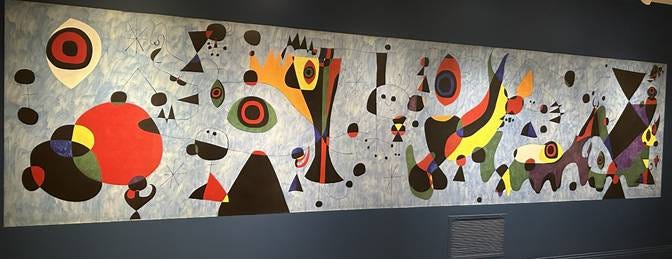
The hotel’s architects, Skidmore, Owings & Merrill, were committed to midcentury modern design and wanted to incorporate modern art in their buildings. Miro′ was commissioned to create a mural for the hotel’s restaurant. The Cincinnati mural, about eight feet by 30 feet on a curved surface, was the occasion for Miro′s 1947 trip to the United States. This was his first visit and it lasted about eight months. During that time he met and interacted with numerous American artists, particularly Alexander Calder.
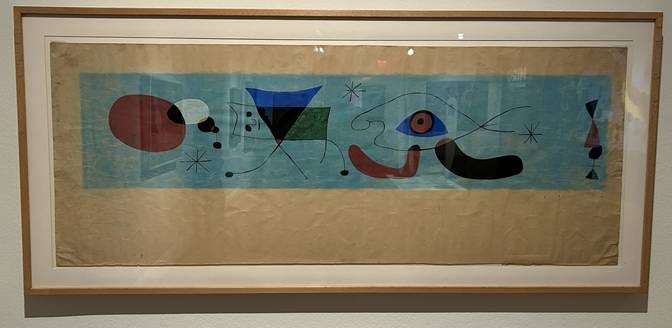
The exhibition also includes a study for a section of the Cincinnati mural:
Why Miro′ Fascinates
Miro′ may be one of the abstract artists whose work provides the best answer to the, “My-five-year-old-son-or-daughter-could-do-that” school of modern art criticism. Miro′s forms are deceptively simple. The intricate composition, or arrangement, of those forms, many of which reappear in his paintings, shows a sophisticated and imaginative aesthetic. Miro′s forms are not scattershot choices; they relate to each other.
Miro′s paintings are also notable for their singularity. His paintings are instantly recognizable as his work. The figures with recognizable facial features—Miro′ called them “personages”—are fun to look for in his paintings and there are just enough of them.
The Constellations
Imaginative complexity that draws us in to look further is a sign of artistic mastery. In 1945, Miro′ had a widely-acknowledged artistic triumph in an exhibition of a series of small oil and gouache (a type of opaque watercolor) paintings that he called the Constellations. Critic Andre′ Breton called the Constellations, “the first message of an artistic kind to reach America from Europe since the onset of the war.” (161)
Lithographs of the Constellations were very popular. They were collected by other artists such as Hans Hoffman, Mary Callery and Robert Motherwell. Artist George Mercer wrote to Lee Krasner about the Constellations, “You refer to the Miro′ show and to the paintings—‘each painting is a little miracle.’ That is a wonderful description. I have stored it and remembered it. I shan’t forget it.” (162)
The Phillips Collection show has several examples of the Constellations, but two stand out:
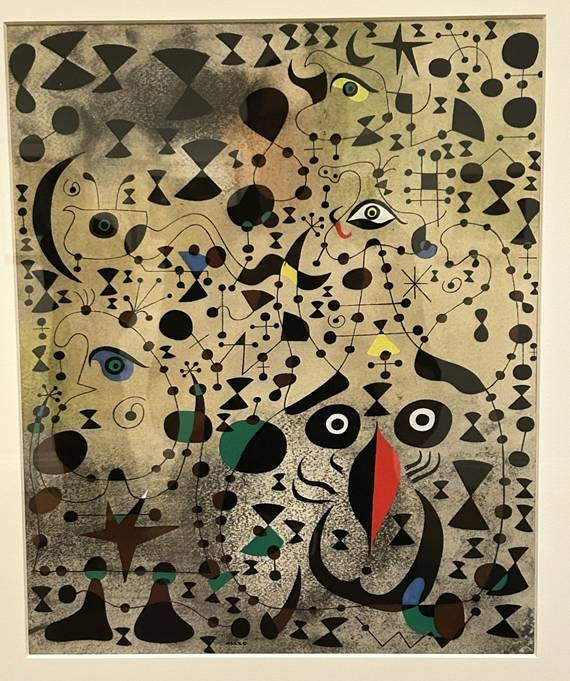
Here, a solid background contrasts with the intricate and connected forms like constellations against the blackness of a night sky. Miroﹶ is working with a reduced palette that makes the sparingly-used colors stand out. Any of three bird-like forms (in yellow, white and blue) could be the beautiful bird. Are the back-to-back cloaked seated figures at the lower left the pair of lovers described in the title of the painting? They appear to be reluctant listeners. Maybe the lovers (and we) will never completely understand what the beautiful bird reveals about the unknown.
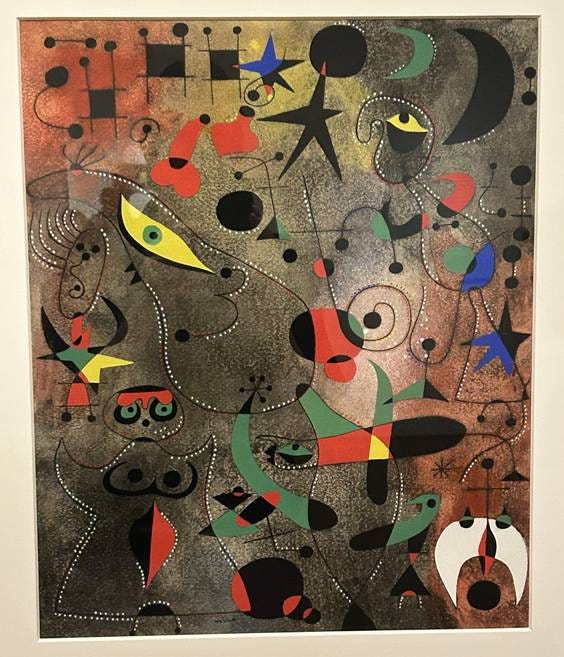
The Poetess is not as detailed as some of the other paintings in the Constellations series, but the more we look, the more there is to see. Here, Miro′ adds color, a more varied background, and uses fewer connections between the forms. The Poetess is described in some accounts as a work of Surrealism. That may be a fair description, but the essence of the work is in its intricate fun. Is that the poetess with her arms outstretched in the lower left of the painting? She seems to be conducting or organizing the figures beside and above her.
Miro,′ the Spanish Civil War, and Arshile Gorky
Miro′ could break the rules of painting because he knew the rules—he had mastered representational painting. Like other artists in Europe, he was affected by the wars in the 1930’s and 1940’s. In 1937, Miro′ fled Spain for Paris because of the Spanish Civil War. While in Paris, he painted Still Life With an Old Shoe, which is now in the collection of the Museum of Modern Art in New York. The painting is often compared to Picasso’s Guernica because of the nightmarish colors and the gloomy clouds which seem to foretell coming dark events.
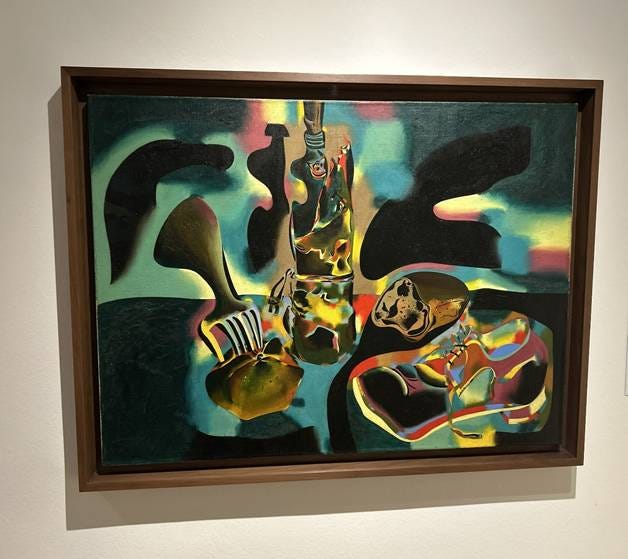
In 1943 or 1944 American artist Arshile Gorky borrowed Miro′s composition in this painting, Garden in Sochi, one of a series of paintings with the same title. This version is displayed next to Miro′s Still Life With an Old Shoe at the Phillips Collection. Seeing the two works side-by-side is a remarkable experience.
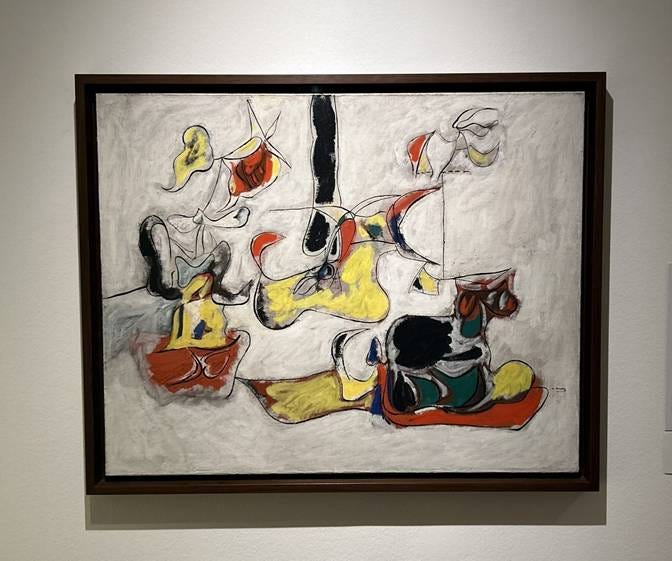
Gorky’s painting recalls his childhood in Armenia. The Hauser & Wirth gallery sees the connection between the paintings by Miró and Gorky this way:
The prevailing motif of the ‘Garden in Sochi’ series is that of a large boot-like form, visible here in red along the lower edge of the composition. Thought to represent his mother’s old-fashioned butter-churn or a Turkish slipper, it is also understood as a direct reference to Miró’s ‘Still Life with Old Shoe’ (1937). Consisting of four symbolic objects: an apple with protruding fork, a shoe, a gin bottle and a broken loaf of bread, Miró’s painting is considered as a response to Picasso’s ‘Guernica’ (1937) and an allegorical expression of protest against the atrocities of war.
The Red Sun
This brief appreciation of the Miro′ and the United States show concludes with one of the Phillips Collection’s many treasures, Miro′s The Red Sun (1948).
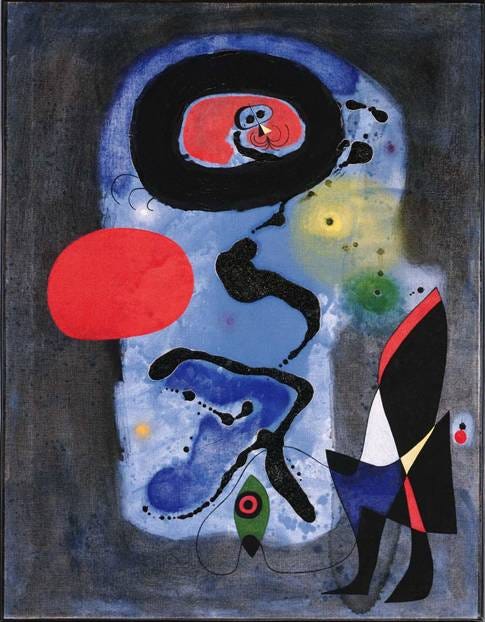
The figure in the blue background is encircled by another red spot to which a few more brush-strokes have been added to make a cheerful little face. Another nattily-dressed figure in the lower right-hand corner of the painting seems to admire the combinations of shapes and colors.
Large and crowded blockbuster exhibitions at behemoth museums—the Metropolitan Museum of Art in New York, the National Gallery in Washington—may be the way of our time. The fascinating Miro′ and the United States show at the accessible and manageable Phillips Collection is a welcome contrast.
Your comments are very welcome.
Nice!